This is the first blog of a series which will explore regulation, ethics and trust in global media planning.
The first of these will explore how recent regulation is shaping the media landscape, and the challenges it poses for planners. Furthermore, it will how explore how brands are navigating legislation to target their audience now that certain means of measurement and tracking data have been taken away from them.
Privacy rules and the challenges legislation is causing for media planners
Privacy regulation has increased the difficulty of media planners being able to reach consumers and deliver personalised messaging, with GDPR(Government Data Protection Act 2018), (GOV.UK, 2018) and the California Consumer Privacy Act 2018 (State of California Department of Justice, 2024) being examples of legislation which have increased marketer accountability and limited available consumer data ( Epstein, M, 2026).
Key principles of GDPR 2018 (GOV.Uk, 2018) were that of lawfulness, fairness, transparency, purpose limitation, data minimisation, accuracy, storage limitation, integrity and confidentiality, and accountability should sit at the heart of data processing decisions. One such example of this was the removal of third-party cookies, which Maya Epstein, global brand director for Nestle cites has been a critical issue for the industry as it hinders the ability to recognise consumers and serve them with the right experience and message (Epstein, M, 2026). Furthermore, audience targeting will be restricted, and with tracking and measurement affected, this will lead to more, ‘last-click’ attribution, which while providing insight for which channels are effective in converting customers into purchasing doesn’t provide the full picture of the customer journey. Thus, making life harder for media planners ( Epstein, M, 2026). Moreover, the public are more conscious of their privacy and how their data is being used with consumers increasingly using ad blockers as well as 25% of adults using private browsers and 50% taking action to protect their privacy (Epstein, M, 2026).
In 2024 the IAB (Interactive Advertising Bureau), published a report, looking at how the industry was adapting to what they labelled as a ‘privacy-by-design ecosystem’ (HOW THE DIGITAL AD INDUSTRY IS ADAPTING TO THE PRIVACY-BY-DESIGN ECOSYSTEM, 2024). In the report the IAB concluded there were four main takeaways:
- The industry has now fully acknowledged the privacy-by-design ecosystem
- Brands, agencies and publishers are making significant organisational changes to adapt
- The market is facing sweeping declines in accessible, high-quality data
- Legislation and signal loss have profoundly impacted media planning and buying.
Focusing in on No.4 the report finds that nearly nine in ten ad buyers report shifts in personalisation tactics, ad spend and their mix of first, second and third-party data. Three quarters are citing selection changes in media channels and KPIs and that ad spend is being focused towards first-party data and engaging audience at scale (HOW THE DIGITAL AD INDUSTRY IS ADAPTING TO THE PRIVACY-BY-DESIGN ECOSYSTEM, 2024).
Furthermore, the IAB report highlights the impact that legislation and signal loss have at organisational levels with 82% of brands, agencies and publishers citing the impact it has had on their business as can be shown in the below images (HOW THE DIGITAL AD INDUSTRY IS ADAPTING TO THE PRIVACY-BY-DESIGN ECOSYSTEM, 2024).
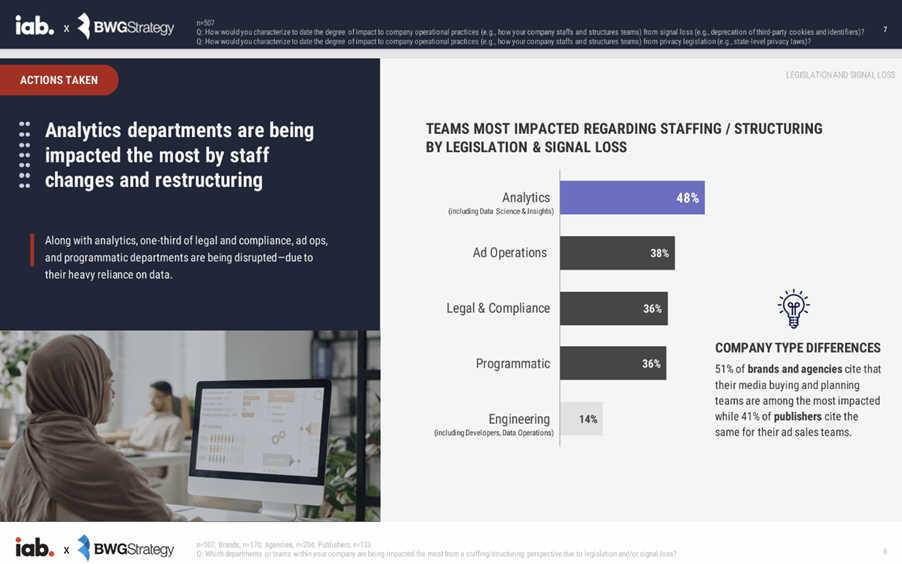
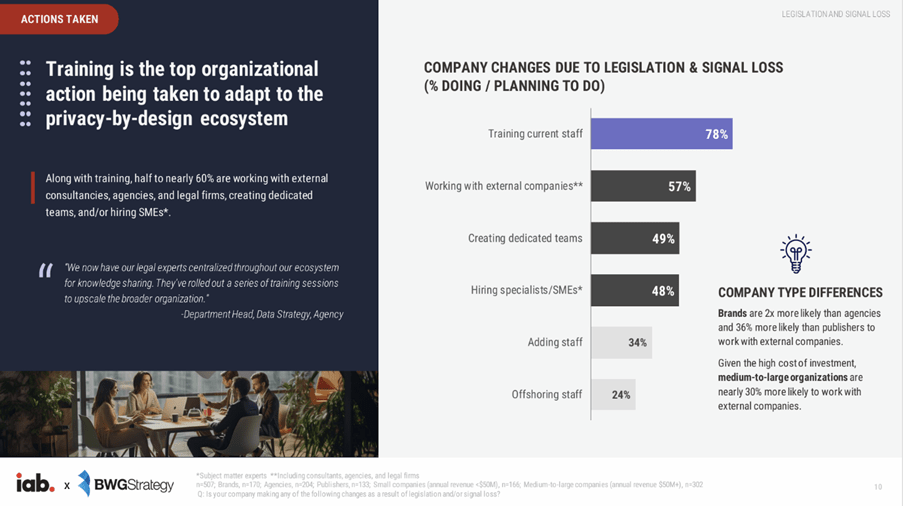
Another issue for planners and marketers is that privacy regulations continue to evolve and change with different touchpoints and companies having differing regulations. As the report highlights, when Apple released IOS 17 in 2023 this saw the removal of URL tracking parameters across mail messages and safari browsing which has made life more difficult for user tracking and campaign measurement (HOW THE DIGITAL AD INDUSTRY IS ADAPTING TO THE PRIVACY-BY-DESIGN ECOSYSTEM, 2024). The knock-on effect being that ad buyers are reducing their spend with it being more difficult to engage with iOS users.
Regulation is raising the value of planning judgement
As the IAB report demonstrates the difficulty with the legislation and privacy regulation is that it is leading to companies having a lack of confidence in the data received and that measurement effectiveness is being disabled by lower data quality and accuracy (HOW THE DIGITAL AD INDUSTRY IS ADAPTING TO THE PRIVACY-BY-DESIGN ECOSYSTEM, 2024).
With the issues facing marketers and planners, it is therefore essential that businesses when planning campaigns are ‘future-proofed’ for an ever-moving world of privacy regulation (Epstein, M, 2026). Therefore, it poses the question of what businesses, brands and agencies are doing to navigate these challenges? The answer is a variety of strategies.
As aforementioned in the IAB report, first-party data is becoming an ever increasing target for advertisers, who are looking to home in on collecting and leveraging this data to gather insight about their customers, as well as incentivising engagement by offering people expense or reward for sharing their data(Warc.com, 2025). Other methods, include data partnerships, with advertisers connecting with publishers, platforms and technology to leverage shared data and insights and this is done through data clean rooms to provide a safe space for customer data (Warc.com 2025). This also further supports the idea that working alongside global media partners is key to navigating the shifts in privacy regulation (Epstein, M, 2026).
Advertisers are also looking at contextual targeting to move away from being reliant on third party-cookies. This includes images, audio, content sentiment, location and weather to target customers (Warc,com, 2025). Advances in technology such as AI have also enabled this to broaden the depth of contextual signals that can be gathered (Warc.com,2025). AI has also allowed new audience segments to be built, having been modelled on first party data from publishers, advertisers and tech platforms (Warc,com, 2025). The breadth of different strategies being used emphasises the knowledge required to develop a successful media plan and the need for agencies to educate clients about the potential changes in regulations (Epstein, M, 2025). Furthermore, it demonstrates why the makeup of businesses and staff is changing in the industry as highlighted by the IAB report.
Conclusion
In summary, regulation and legislation, around privacy have had a significant impact on media planners with access to customer data increasingly more difficult to track and the data that is being received increasingly more unreliable. Brands, agencies, publishers and platforms are now navigating different ways to gain access to this data and target their customers and wider audience.
The next blog in this series will look at how important trust is for media planners.
 Archie Connolly Sport