The Ethical Challenges Facing Media Planners in the Data Industry

In the first two blogs we looked at the impact of regulation and legislation as well as the value that trust still plays for media planners, for people to continue to engage with brand.

However, whilst media planning has always been about reaching the desired audience, in the increasingly diverse data driven ecosystem, getting to them has become ethically more complex.

How to harness data whilst also respecting privacy and being transparent with the consumer

In the first blog we looked at how legislation was making it more difficult to map the customer journey, however there is still more customer data out there than ever before and therefore with privacy also more important than ever before how to manage that customer data has become ever more important for brand owners (Warc.com, 2025).

The internet is moving towards its third incarnation known as Web 3.0.  This is hoped to be a more decentralized version of the internet with apps and services powered by blockchains where people will have more control of their data and that it will be more transparent (Warc.com, 2025).

In the second blog we looked at a ‘greenwashing’ scandal involving Swedish Manufacturer, IKEA, where it was revealed that the wood they were logging wasn’t coming from sustainable sources (Disclose.ngo. (n.d.)..

However, when it comes to data, IKEA wanted to be as transparent as possible with their customers and in 2020 they released a Youtube video with Barbara Martin Coppola, Chief for Digital Office for the Ingka Group, which explained how Ikea was looking to embed data ethics into everything they do in a simple and transparent way (IKEA, 2020).

One of the key points IKEA looked at in the video was prior to regulation companies had often operated as if customer data was their own, and that when it comes to data most people didn’t understand the short and long term implications of data use, there was a lack of trust, in that people didn’t believe that companies had their best interests at heart and a lack of transparency, with terms and conditions changing frequently, requiring people to read lengthy legal texts. IKEA wanted to shift that narrative and give people belief that they were in control of their own data (IKEA, 2020).

In the video IKEA set out a clear vision and mission for its Data Ethics. They wanted to enable a people-centric approach to digitisation and new technologies, which aligned with its mission of creating a better everyday life for many people. Furthermore, they wanted to change how they collect, review and manage data, redesigning and rethinking everything through the lens of data ethics, giving control to their customers by allowing co-creation with the new privacy features (IKEA, 2020).

The lengths to which IKEA went to explain their position on data is indicative that trust in companies to manage their data effectively and ethically is extremely low amongst the public. A 2023 survey conducted by ad-targeting business Nano interactive found that UK customers are increasingly concerned about giving up personal data and not convinced by the industry’s value-exchange argument (Warc.com, 2025). Furthermore, in the U.S according to a 2023 survey by Pew Research Center, 77 % of respondents had no trust in leaders of social media companies to publicly admit mistakes and admit data misuse and 76% do not trust these companies to not sell personal data to others without consent ( Warc.com, 2023).

Additionally, a 2019 study conducted by the Advertising Research Foundation found that consumers are becoming less willing to share personal data such as home and personal email addresses and telling people that sharing that data would allow for a more personalized experience did not make them more willing to share and on top of that  a 2020 Dentsu agent study found that misuse of data was the number one source of distrust in the technology industry(Warc.com, 2025). These findings illustrate the challenges for media planners in gaining personal data and trust from the public.

On a more positive slant for media planners and companies, one global study in 2019 did find that a lot of people would be willing to share data if they knew it would be secured safely and that the collector was reliable and was clear about the need and reasons for wanting the data (Warc.com, 2025) . Thus, giving hope to media planners and brands if they can show that pathway and demonstrate their trustworthiness i.e. the IKEA video.

Conclusion: Ethics as a Planning Advantage

The data industry has developed powerful tools in being able to store and use data but for media planners to be able to showcase how their brands or companies ethically use that data is vital in maintaining trust with the consumer and will be the reason why they will be successful.

Why trust is so important for a media planner

In the previous post we looked at the impact of regulation and legislation particularly privacy had for media planners.

In this post we will look at why trust remains such a vital commodity for a media planner.

Trust Influences Whether Audiences Engage

With advances in technology, the adoption of machine learning has meant that brands nowadays can react quicker to changes in customer needs which include campaign optimisation and dynamic content planning for personalised messaging. Mary Epstein, global brand manager for Nestle argues that despite much debate over the last 10 to 15  years , the basic principle of how we build a brand hasn’t changed, and that technology is merely a vehicle to magnify those truths and enable quicker execution ( Epstein, M, 2026).  Aeker, 2014 defines brands as more than just names and logo, more that, ‘they are an organisation’s promise to a customer to deliver what the brand stands for not only in functional benefits but also, emotional, self-expressive and social benefits’.  

As touched upon in the previous blog with the public increasingly more interested in privacy, brands really have to stand out to be able to get customer engagement, with authenticity being a key component in gaining trust with consumers, in a world where sustainability is a key issue amongst younger generations andth therefore brand’s must ‘walk the walk’ and deliver on their commitments, there is no room for ‘greenwashing’ (Epstein, M, 2016). ‘Greenwashing’, meaning the practice of misleading the public into believing a product, company or service is more environmentally than it is. One notable example of a company greenwashing was Swedish manufacturer IKEA, who were found to have got their wood from unsustainable logging sources and their response to the allegations has drawn heavy criticism, with lack of independent oversight causing question around the brand’s commitment to their sustainability promises (Disclose.ngo. (n.d.). 

How Media Planners Can Put Trust Into Practice

Media Planners have an important role in developing trust with their consumer base and this can be done by reinforcing those brand values through campaigns, communications and advertising. For example, Nestle have demonstrated their sustainability commitments, with Nespresso revealing their plans to be carbon neutral in 2022, Purina in 2023 focusing on being more transparent and removing artificial colourants and KitKat committed to being carbon neutral by 2025, getting those messages is vital to help spread those brand values.

Furthermore, the scope in the media landscape is much bigger for brands. Numerous platforms have allowed media planners to move towards content led advertising, largely to compete with consumers engaging on streaming and notable examples being Dove releasing a documentary on Apple +, which was produced by Lavazza, the aim being to discuss their brand purpose without it appearing like a regular tv ad for example. Furthermore, this approach enhances brand visibility and authenticity without trying to ‘sell’ directly and this can have greater PR Value arguably greater than direct viewership (Epstein, M, 2026).  

Summary

In conclusion, trust remains a key tenet for brands to be able to engage with their consumer base. Without it people will look to other brands who match their values and, in a world, where people are increasingly private it is essential that media planners can convey trustworthiness for their respective brands in order to cultivate engagement from their desired audience.

The final blog in this series will look at further ethical challenges in the data industry is facing and how businesses are having to ensure they are adopting responsible behaviour.

The Impact of Regulation on Media Planners

This is the first blog of a series which will explore regulation, ethics and trust in global media planning.

The first of these will explore how recent regulation is shaping the media landscape, and the challenges it poses for planners. Furthermore, it will how explore how brands are navigating legislation to target their audience now that certain means of measurement and tracking data have been taken away from them.

Privacy rules and the challenges legislation is causing for media planners

Privacy regulation has increased the difficulty of media planners being able to reach consumers and deliver personalised messaging, with GDPR(Government Data Protection Act 2018), (GOV.UK, 2018) and the California Consumer Privacy Act 2018 (State of California Department of Justice, 2024) being examples of legislation which have increased marketer accountability and limited available consumer data ( Epstein, M, 2026).

Key principles of GDPR 2018 (GOV.Uk, 2018) were that of lawfulness, fairness, transparency, purpose limitation, data minimisation, accuracy, storage limitation, integrity and confidentiality, and accountability should sit at the heart of data processing decisions.  One such example of this was the removal of third-party cookies, which Maya Epstein, global brand director for Nestle cites has been a critical issue for the industry as it hinders the ability to recognise consumers and serve them with the right experience and message (Epstein, M, 2026). Furthermore, audience targeting will be restricted, and with tracking and measurement affected, this will lead to more, ‘last-click’ attribution, which while providing insight for which channels are effective in converting customers into purchasing doesn’t provide the full picture of the customer journey.  Thus, making life harder for media planners ( Epstein, M, 2026).  Moreover, the public are more conscious of their privacy and how their data is being used with consumers increasingly using ad blockers as well as 25% of adults using private browsers and 50% taking action to protect their privacy (Epstein, M, 2026).

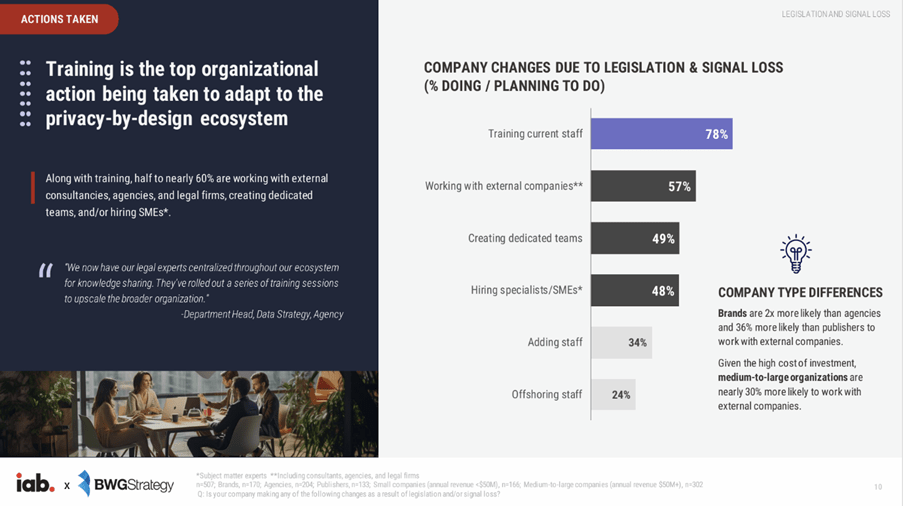
In 2024 the IAB (Interactive Advertising Bureau), published a report, looking at how the industry was adapting to what they labelled as a ‘privacy-by-design ecosystem’ (HOW THE DIGITAL AD INDUSTRY IS ADAPTING TO THE PRIVACY-BY-DESIGN ECOSYSTEM, 2024).  In the report the IAB concluded there were four main takeaways:

  1. The industry has now fully acknowledged the privacy-by-design ecosystem
  2. Brands, agencies and publishers are making significant organisational changes to adapt
  3. The market is facing sweeping declines in accessible, high-quality data
  4. Legislation and signal loss have profoundly impacted media planning and buying.

Focusing in on No.4 the report finds that nearly nine in ten ad buyers report shifts in personalisation tactics, ad spend and their mix of first, second and third-party data. Three quarters are citing selection changes in media channels and KPIs and that ad spend is being focused towards first-party data and engaging audience at scale (HOW THE DIGITAL AD INDUSTRY IS ADAPTING TO THE PRIVACY-BY-DESIGN ECOSYSTEM, 2024). 

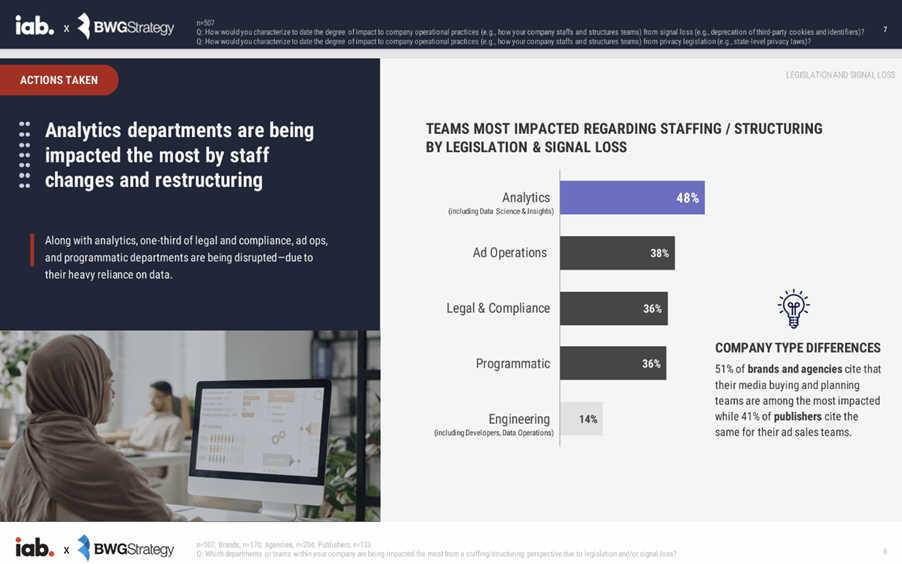
Furthermore, the IAB report highlights the impact that legislation and signal loss have at organisational levels with 82% of brands, agencies and publishers citing the impact it has had on their business as can be shown in the below images (HOW THE DIGITAL AD INDUSTRY IS ADAPTING TO THE PRIVACY-BY-DESIGN ECOSYSTEM, 2024). 

Another issue for planners and marketers is that privacy regulations continue to evolve and change with different touchpoints and companies having differing regulations.  As the report highlights, when Apple released IOS 17 in 2023 this saw the removal of URL tracking parameters across mail messages and safari browsing which has made life more difficult for user tracking and campaign measurement (HOW THE DIGITAL AD INDUSTRY IS ADAPTING TO THE PRIVACY-BY-DESIGN ECOSYSTEM, 2024).   The knock-on effect being that ad buyers are reducing their spend with it being more difficult to engage with iOS users.

Regulation is raising the value of planning judgement

As the IAB report demonstrates the difficulty with the legislation and privacy regulation is that it is leading to companies having a lack of confidence in the data received and that measurement effectiveness is being disabled by lower data quality and accuracy (HOW THE DIGITAL AD INDUSTRY IS ADAPTING TO THE PRIVACY-BY-DESIGN ECOSYSTEM, 2024).

With the issues facing marketers and planners, it is therefore essential that businesses when planning campaigns are ‘future-proofed’ for an ever-moving world of privacy regulation (Epstein, M, 2026).  Therefore, it poses the question of what businesses, brands and agencies are doing to navigate these challenges? The answer is a variety of strategies.

As aforementioned in the IAB report, first-party data is becoming an ever increasing target for advertisers, who are looking to home in on collecting and leveraging this data to gather insight about their customers, as well as incentivising engagement by offering people expense or reward for sharing their data(Warc.com, 2025). Other methods, include data partnerships, with advertisers connecting with publishers, platforms and technology to leverage shared data and insights and this is done through data clean rooms to provide a safe space for customer data (Warc.com 2025). This also further supports the idea that working alongside global media partners is key to navigating the shifts in privacy regulation (Epstein, M, 2026).

Advertisers are also looking at contextual targeting to move away from being reliant on third party-cookies. This includes images, audio, content sentiment, location and weather to target customers (Warc,com, 2025). Advances in technology such as AI have also enabled this to broaden the depth of contextual signals that can be gathered (Warc.com,2025). AI has also allowed new audience segments to be built, having been modelled on first party data from publishers, advertisers and tech platforms (Warc,com, 2025).  The breadth of different strategies being used emphasises the knowledge required to develop a successful media plan and the need for agencies to educate clients about the potential changes in regulations (Epstein, M, 2025). Furthermore, it demonstrates why the makeup of businesses and staff is changing in the industry as highlighted by the IAB report.

Conclusion

In summary, regulation and legislation, around privacy have had a significant impact on media planners with access to customer data increasingly more difficult to track and the data that is being received increasingly more unreliable. Brands, agencies, publishers and platforms are now navigating different ways to gain access to this data and target their customers and wider audience.

The next blog in this series will look at how important trust is for media planners.

The stats behind Bristol Bears’ difficulties since 2021 Gallagher Premiership semi-final defeat to Harlequins

On the 19th of June 2021, Bristol led Harlequins 28-0 in the semi-final at Ashton Gate and Pat Lam’s side looked destined to end their stellar season with a first appearance in the Gallagher Premiership final.

However, over the next couple of hours, the Bears faithful had their dreams dashed as Quins roared back to complete an improbable win, running out 43-36 winners after extra-time.

Despite the disappointment of losing in the manner that they did, owner Stephen Landsdown put his full faith in Pat Lam by handing the former Samoan international a seven-year contract.

The contract raised eyebrows at the time due to its length, however, there was little doubt that Lam deserved reward, having coached Bristol to promotion from the championship, winning the European Challenge Cup in 2020 and guiding the Bears to a top of the table finish during the regular season in 2020/21.

However, after their brilliant season in 2020/21, the next two seasons have been underwhelming.

The Bears went from finishing first in the 2020/21 campaign to ending the 2021/22 regular season in 10th place.

Whilst many thought that might be a blip, the reality has been anything but and the 2022/23 season has seen the side finish 9th and this final position was in an 11-team league.

Therefore, it is fair to question what is behind the drop off in form which has seen a side finish first one year to residing near the bottom of the table in the two following seasons.

The basic statistics make pretty grim reading.

In 2020/21 the Bears won 17 games out of a possible 22, in the next two seasons they have won 16 games combined.

Another huge difference is in their points for and against.

In 2020/21 the Bears points differential was +182, scoring 75 tries and conceding 42.

In 2021/22, the Bears points differential was -145, and whilst their attack remained potent, scoring 73 tries only two fewer than the previous season, they conceded more than double, letting in 98.

However, there was improvement in 2022/23, albeit there were two fewer games, the points differential improved sitting at -21 and the attack was strong scoring 72 tries whilst the defence conceded 65.

Embed from Getty Images

(It has been a difficult period for Pat Lam (pictured above) )

The natural response is to ponder what are the reasons behind such a drop off in performance.

Discipline has been cited as a key factor in Bristol losing games, but across the last three seasons the Bears have been by no means the worst offenders.

In 2020/21 the Bears ranked fifth in the table for penalties conceded, giving away 244.

In 2021/22 they were penalised 279 times which ranked them 8th against other Premiership sides.

In 2022/23 the Bears returned to 5th in this table, having been whistled against a total of 243 times, and whilst that is similar 2020/21 it must again be noted that less games were played.

Furthermore, in the past three seasons the Bears have consistently been near the top of the metres gained charts.

In 2020/21, they were first, in 2021/22 they were second and in 2022/23 they were second again, illustrating that gaining ground has not appeared to be an issue for Pat Lam’s side.

Although, despite their ability to advance the ball it is their lack of cutting edge which has cost them.

In 2020/21, the Bears were third in the table for points scored. In comparison, the following two seasons they were ranked 9th out of 13 in 2021/22 and then 9th out of 11 in 2022/23.

For a club with the talent that Bristol Bears have it is an illustration of the struggles that they have had since they lost that semi-final in June 2021.

There are of course factors which have influenced these statistics.

Injuries to key players have blighted the Bears over the last couple of seasons, with stars such as Semi Radradra, Harry Randall, Charles Piutau and Steven Luatua to name but a few have all had sustained periods on the side lines.

In addition, Ben Earl and Max Malins were significant contributors to the Bears success and were valuable players to have on loan from Saracens, who were forced to spend the 20/21 season in Championship exile having been convicted of financial misgivings.

For context, in that season Malins excelled, scoring 9 tries whilst on loan, the most of any Bears player and his colleague Ben Earl also had a huge impact scoring five tries from the back row.

Regardless of injury and talent moving on,  the Bears have still seen a poor return on the investment they have made in their side.

Big names such as Ellis Genge, AJ Macginty and Gabriel Ibitoye have come through the door at Ashton Gate, but two seasons outside the Champions Cup positions is a dismal return for the quality that the Bears have had at their disposal.

Another criticism that has been levelled at the Bears is their failure to win close games.

Across the last two seasons the Bears have recorded nine losing bonus points. Whilst in some scenarios that may be regarded as a positive outcome, it could be argued that is also nine games gone begging and that extends to ten when you consider the draw against Leicester where Macginty missed a relatively simple penalty at the death, which would have given the Bears another win.

Tight games are unsurprisingly won by fine margins and a key area is the turnover battle.

Crucially, in the turnovers won charts in the 2022/23 season no Bears players feature in the top 10 in this metric.

Grinding out results has been a challenge for Bristol and if you are struggling to disrupt your opposition’s ball, it can make a big difference in close games which is maybe a telling factor in the Bears’ struggles.

Another statistic which makes interesting reading is the results from winning and losing positions.

When the Bears finished 1st in 2020/21, Bristol led at half time 12 times and only failed to win once, a game which they drew. Moreover, when trailing at the break, they came back to win an impressive three times out of five.

Since then, unsurprisingly the Bears record has not been as good. In 2021/22 the Bears lost more than they won when in front at half-time losing 5/9 times. Another damning indictment was that the Bears trailed 11 times and could only reverse their fortunes on two occasions.

In 2022/23 when in front at the break the Bears went onto win eight out of 10 times but could only reverse a half-time deficit on one occasion out of 11 and drawing against Leicester on the other.

https://rugby.statbunker.com/competitions/HalfTimeTableLose?comp_id=702

(Must be noted one of their wins came against Wasps and was not counted in the official table.)

Those figures demonstrate that the Bears are a far cry from their 2020/21 selves and have languished at the wrong end of the table.

Malins will return to Ashton Gate for the 2023/24 season which will be a boost given he led the try scorer charts last season with 16 and has continued his excellent form in 2022/23 having again reached double figures for tries scored.

There is also a lot of quality leaving the Bears.

Superstars Piutau and Radradra will join Luke Morahan as players to depart Ashton Gate. Furthermore, with Ioan Lloyd, Andy Uren, Toby Fricker and Henry Purdy also leaving, the future success of Bristol looks anything but certain.

Piutau will be a huge miss for the Bears, as even when the Bears have struggled, he has remained a notable threat.

In 2022/23, the former All-Black was second in the metres gained chart, going for a total of 1188 metres and he was also fifth in the charts for defenders beaten, managing to go past 54 players throughout the season.

Embed from Getty Images

(Above: Charles Piutau in action against Gloucester in his last game for the club)

In 2021/22 injuries played a factor in a lower performance from the full-back but again when Bristol was strong the season prior, so was Piutau, sitting third for metres gained.

More articles like this: https://www.devonlive.com/sport/rugby/match-reports/exeter-chiefs-player-ratings-bristol-7110721

https://www.bristolpost.co.uk/sport/rugby/match-reports/bristol-bears-player-ratings-historic-7836236

There is no doubt his absence will leave a void at Ashton Gate but how Bristol replace their stars and work to a better collective performance will make interesting viewing as Pat Lam looks to right a ship that has seemingly stumbled off course in the last couple of seasons.

France’s fall and rise- Galthie’s men search for Grand Slam to end 12 year wait

On March 12, 2010, France defeated England 12-10 to complete the grand slam. France haven’t won a Six Nations since. They are now one game away from returning to the top of European International rugby.

Embed from Getty Images

It is a barren spell that is even more striking given that when the Five Nations became the Six Nations in 2000, France won five out of the first 11 tournaments. Not only have they not won the competition since, but they have also only finished in the top two twice, in 2011 and 2021.

Added to the victories of the 2000’s their back-to-back grand slams in 1997 and 1998 make their period in the wilderness even more surprising.

Furthermore, the fate of the French National team since 2010 and by extension 2011, where they lost 8-7 in the World Cup Final to New Zealand. is more emphatic considering they boast the richest league in the world.

One might think that investment and financial power could and should lead to success but as the English Premier League in football has shown, that is by no means a guarantee of success.

French clubs have recruited heavily and again like the English Premier League a lot of that recruitment has been for overseas players.

At club level for example, Toulon won an unprecedented three Heineken/ European Cups in a row from 2013-2015.

However, the make-up of their winning teams were anything but French.

In the 2013 final, Toulon had four French Players in their starting lineup, in 2014, they had three and in 2015 they had four.

In those finals less than a fifth of the starting fifteen were French which could be a factor as to why their form has been dire over the last decade.

Despite their club game being as strong as ever the plight of the National Team plummeted.

In 2013 France lost to Italy and finished bottom of the Six Nations, emphasizing their decline from a Grand Slam in 2010 and World Cup final appearance in 2011.

All sides have cycles and that 2010 team for France was perhaps coming to the end of one.

Some of their great players of the 2000’s, the likes of Yannick Jauzion, Dimitri Yachvilli, Imanol Harinordoquy and Sebastien Chabal were all beginning to enter the twilight of their careers and unfortunately for France it has taken over a decade to replace them.

Under Phillipe Saint-Andre, Guy Noves and to lesser extent Jacques Brunel the rugby was turgid, often reliant on Mathieu Basteraud to bulldoze through the midfield and put simply there was no excitement in their game.

The great French sides have always possessed an element of attacking exuberance and it became known as ‘French flair’, that has dissipated during this period.

They were thrashed by New Zealand 62-13 in a World Cup final and endured painful defeats in the Six Nations when blowing leads, notably at home to Ireland in 2018 before blowing a 16-0 half time lead against Wales a year later.

They possessed a capacity to blow up, highlighted by Sebastien Vahaamahina’s red card for an elbow which arguably cost them their World Cup quarter final against Wales in 2019.

Embed from Getty Images

However, despite this there were signs under the surface that a French revolution may not be too far away.

In 2018 and 2019 France’s U20’s won the junior World Cup, highlighting a potential and golden generation and so far they’ve made an auspicious start.

Led by Antoine Dupont, who was crowned World Rugby Player of the year in 2020 this side not only could end twelve years of hurt but has the potential to dominate for years.

Their pack is ferociously strong, led by Cyril Baille in the front row and the athleticism of Cameron Woki and Gregory Aldritt is the envy of many.

Outside Dupont his club teammate Romain Ntamack is class personified and after the soild midlfied duo of Gael Fickou and Jonathan Danty they have serious weapons outside them in Gabien Villiere and Damian Penaud who have been electric. Melvyn Jaminet has also been superb from the tee and has cemented a place despite playing in France’s second tier last year.

Credit must go to Falbien Galthie who’s appointment of defence master Shaun Edwards has been a masterstroke in developing this French side so that it is as tough as it is thrilling with ball in hand.

In recent years France would have wilted when Ireland came back at them, folded when Scotland attacked them and crumpled in the cauldron of Cardiff. Not this team.

This side withstood those challenges and are now on the cusp of being back at European Rugby’s precipice with only England standing in their way.

It is the biggest game of Galthie’s era and if they can defeat England in Paris on Saturday it will be a huge moment ahead of their home World Cup in 2023.

Honeysuckle lights up Cheltenham as the crowds pour back into Prestbury Park

When I spoke to a friend on Monday he described the Cheltenham Festival as like Christmas but better and after the events of Tuesday at Prestbury Park on Tuesday it’s hard to disagree.

Christmas is about socializing, for many it’s about drinking and having a good time, Cheltenham provides all that, it’s a week of escapism and a chance to enjoy unrivalled sporting theatre but last year Christmas didn’t come.

Last year, people watched and enjoyed the racing but it wasn’t the same. There was no socializing, no roar and the greatest show on turf was played in front of no audience as pandemic protocols  relegated us all to watch from afar.

The phrase, ‘absence makes the heart grow fonder’ perhaps, never more apt than the 15th March 2022 as whilst last year the home of jumps racing had no occupants, this year they returned in their droves.

68,567 piled through the gates to set a record attendance for the Tuesday at the Festival.

The walk up to the course evokes memories such as 2015 where the agony of Annie Power’s fall still haunts many a racegoer.

As the gates approached, and fans flocked to get in the view from trackside is enough to warm the heart of any sporting fan.

A look at Cheltenham before the racing started

Less heartwarming was the £7 for a pint of Guinness, but against the Carling at £6.90 the Guinness was far better value.

As 13:30 approached the grandstand was packed as people prepared for the beginning of the four biggest days of the racing calendar.

After a brief hush, the horses approached the tape and there was a huge cresecendo as 24 months since fans last saw a festival race was about to end, the crowd were ready to roar. False start.

Nervous laughter amongst frustration was palpable as the horses came again and this time they were off and a deafening cacophony reverberated around Cheltenham the festival was finally underway.

The noise increased again as the horses flashed past the grandstand and then dies down before the stunning climax of the Supreme.

Dysart Dynamo fell and left the race at the Nicky Henderson duo of Jonbon and Constitution Hill’s mercy, and the latter seized full advantage streaking home by 22 lengths to send the crowd wild and get the punters off to a flying start.

The racing seemed to fly by after that, Edwardstone won the Arkle for Scotland and Corach Rambler finished like a train to give Lucinda Russell a winner and Britain after a 23-5 drubbing last year were now 3-0 up.

There was a second win for Nicky Henderson as Marie’s Rock won a scrappy mares hurdle before Brazil won a thriller in the boodles and Willie Mullins got on the board in the last.

However, that was all after a queen regained her crown in the Champion Hurdle in stunning fashion.

Questioned by some about whether her 14 wins from 14 races was good enough from, coming round the bend Honeysuckle and Rachel Blackmore banished the doubters as they stormed home to make it a fabulous 15 from 15.

The crowd showed their adulation as she entered the winners enclosure in a spine-tingling reception befitting of a special mare who reminded everyone on the first day of the festival why Cheltenham is a place like no other.

Jane Taylor opens up on her debut Netball Super League season, England Students and her family’s support

At 21, Jane Taylor has already enjoyed a season with the Severn Stars in the Netball Super League and represented England Students.

For most that would be something to be proud of and happy with but during my chat with her, what is striking is the brutal honesty with which she assesses her own performance.

“I’m very harsh on myself as a player. Even though my coach said you played really well, I was like no I didn’t. I always focus on the bad things that I do. I think that’s any athlete really. I think you’ll always remember the stuff you did wrong and you’ll think I should have done better.”

Her candour is refreshing but she also appears to possess a remarkable self-awareness and concedes that her foray into the Super League may have come too soon.

This year Taylor is still involved with the Stars but as a training partner and whilst a setback she feels it may benefit her in the long run, especially whilst she is studying for a masters in Sports Therapy at the University of Gloucestershire.

“I think my debut season was a bit premature for me, if I’m being truthfully honest, I don’t think I was ready. I didn’t expect it anyway because I didn’t have a full season as a training partner. Finding out this season that I’m not fully in the squad and I’m a training partner, felt like a step backwards but in the right direction. That’s a bit strange but I can focus on my masters I can improve on that, really focus on my netball and then having this on top being able to represent England makes me feel like, I’m not bad at netball, it’s worth it.”

What is apparent when talking to Taylor is that her call up to England Students came at an opportune time and was also a massive source of pride despite her initial anxiety to receiving the news.

“I didn’t open it on the day because I didn’t want to find out. I think I had something on where if I didn’t get in, I didn’t want it to ruin it. And then the next day when I was on my own, I just opened it and it said congratulations and I was ecstatic.

It was very good news at the time and I kind of needed it. Just to say yes you had a setback in the NSL, but you’ve also had a step forward with England Uni, so it was good.”

University of Gloucestershire students, Jane Taylor (left) and Millie Pittaway (right) have both represented England Students this year.

Making your debut during a pandemic poses even more challenges, in particular with the absence of crowds and in particular loved ones, especially with the support she has from her own family.

“My family are really supportive and come whenever they can. I really missed not having family watching me play last season. Especially with it being my debut season. “

With two older sisters who were sporty as well as her parents, sport permeated family life for Taylor growing up.

It is evident what her family mean to her but she is also grateful for the competitive spirit that her family environment has fostered.

“Sam and Catherine, and myself were really into sport. And I think, it really comes from my Dad, he is and was very sporty when he was younger. He also went to the same secondary school as us, Chosen Hill School, which is only ten minutes away. He was very much into his rugby and he played for his club, and I think he got pretty far and I think he might have had a trial for England, like the 21’s or something, not the actual England squad.

We’re just quite a sporty family and we used to be in this thing called Young Farmers club and they ( Mum and Dad) used to play in this mixed hockey team and were very competitive. We all hate losing and the drive to be really good at what we do and to win definitely comes from them.”

The desire to improve is no more apparent when I mention her stats in the Super League.

In her debut season she scored 36 goals from 47 shots which from the outside appears like a good return but not for Taylor herself.

“Our normal (percentage) is 85 so to hear 74 is not what I want to hear. So if I ever get the call up to play this season ill definitely be trying to make sure I get the majority in, or only miss one or two in a game. I don’t want to miss too many because that’s our job as a shooter, our main priority is too get the goals in. If we don’t do our job then what are we doing it for, that’s what my mindset is.”